
Early Childhood Care and Education (ECCE): Meaning, Importance, and Future Opportunities
Ever wonder how a country grows into a superpower? Is it in a day? a month? a year? Takes time right! And where does that begin you ask….? Not in its parliaments or its boardrooms, but the very classrooms where the basics are taught – and even before that, in preschools and kindergartens.
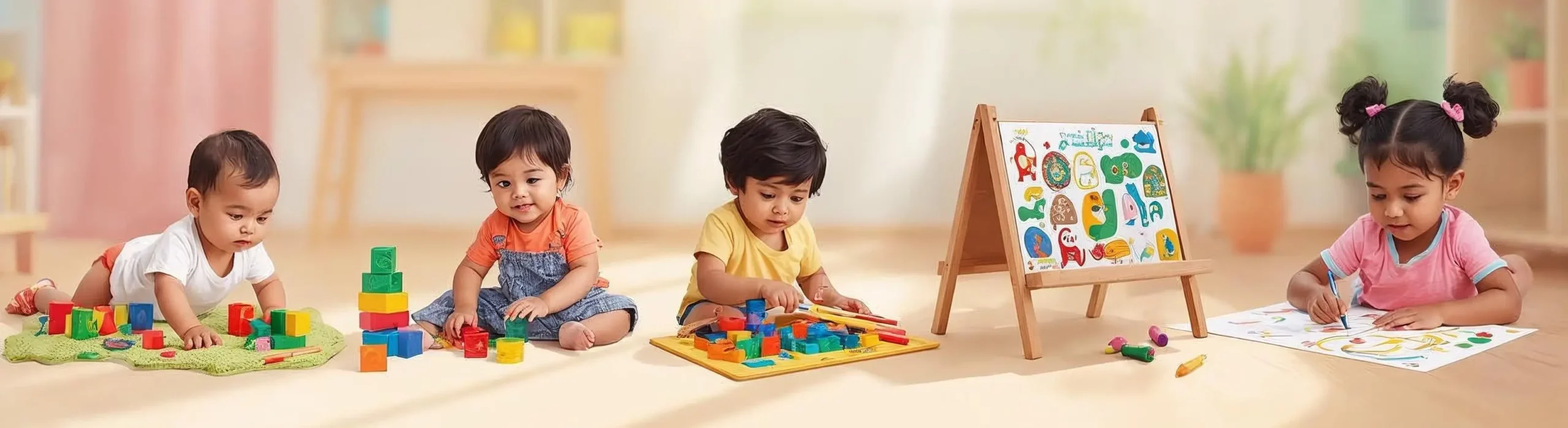
Our brains are developed 90% by the age of 6 (NIOS), that directly translates to understanding that we develop most of our emotional, cognitive, and social skills in those early years. These are not just play-and-learn sessions – they build us as humans, teaching us problem-solving, creativity, empathy and resilience.
So if we’re talking about shaping a future workforce, build innovators, or nurture empathetic leaders, the foundation doesn’t lie only on the basis of advanced degrees, it’s the Early Childhood Care and Education – the stage where a child learns the basics of becoming an amazing individual, learning how to connect, imagine and execute.
Let’s understand why ECCE Matters
According to Neuroscience the “Window of Opportunity” is in the early years, basically ages 0-8, which makes it all the more important to pay attention to how we nurture, guide and engage children during this phase. The brain is at its most flexible, curious and absorbent. Meaning the right environment and stimulation can set the stage for lifelong learning, confidence and success.
Complementing the same with ECCE a child gains stronger reading, numeracy and problem-solving skills using play-based learning.
James Heckman, a Nobel Laureate famously claimed that for every 1$ invested in early years of a child’s education returns up to 7$ in long term social and economic benefits – through improved health outcomes, better employability and lesser crime.
The Global Landscape: Numbers Tell the Story
Despite its proven value, access to ECCE is far from universal:
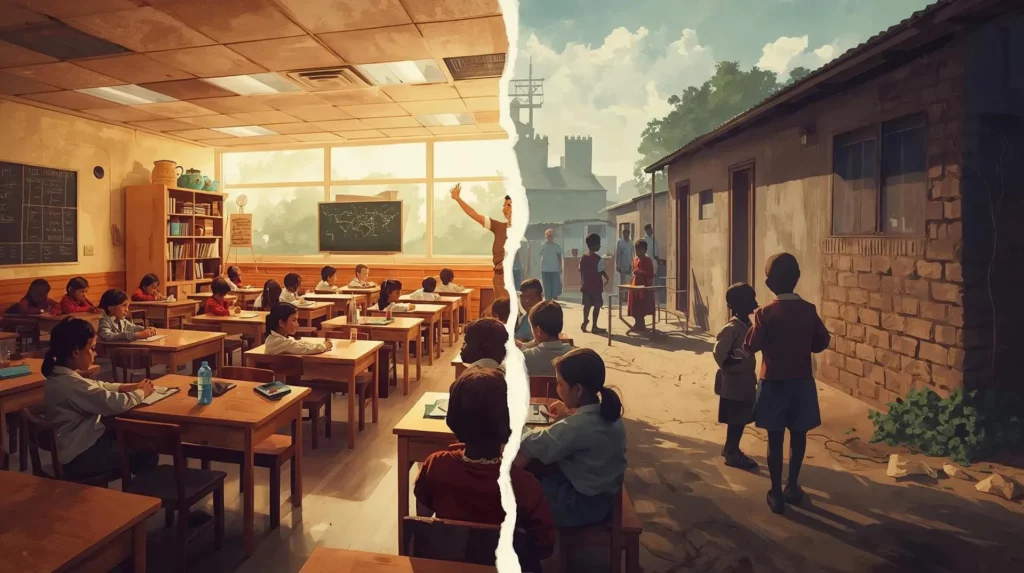
- 91% of children in high-income countries participate in pre-primary education.
- In contrast, only 45% in low-income nations have access (UNESCO).
- 4 in 10 children aged 3–4 attend early education (Wikipedia).
The difference in workforce is similarly noticeable. To meet SDG 4.2 (universal access to quality ECCE by 2030), Approximately (UNESCO).
Salaries & Employability Overseas
- In Luxembourg, early childhood educators can earn over $109,000 annually.
- In Germany, salaries reach $90,970.
- The U.S. average is $36,270 annually, with cities like San Francisco paying $28/hour (Indeed; StoryKate).
Yet, the sector faces a $21 billion annual funding gap globally, underscoring both the urgency and opportunity for investment (UNESCO).
ECCE in India
India faces both, the biggest challenge and greatest opportunity for ECCE, with approximately 158 million or near to 16 crore children under the age of 6 (Central Square Foundation) & (mospi).
Current Infrastructure
Did you know, Our country has over 13 lakh operational Anganwadi centers, serving as the foundation for the country’s ECCE delivery (PIB). These centers, which usually double as nutrition hubs, serve to rural and tribal communities. Despite their great reach, they face issues of infrastructure, overcrowding, and limited focus on learning.
Enrolment & Participation
- In 2020, 87.2% of children were enrolled in some form of organized learning a year before primary school (Times of India).
- The government targets 95% by 2025 and 100% by 2030.
- Yet, only 47.3% of four-year-olds and 46.5% of five-year-olds are in pre-primary education (among the lowest globally, OECD).
Alarmingly, nearly 37 million Indian children lack access to any form of ECCE (Drishti IAS). Many are pushed directly into Grade 1 without adequate preparation, perpetuating inequalities.
Workforce & Salaries
According to the TISS Report, 85-87% of ECCE posts are occupied by women, Indicating a highly feminine workforce. However, salaries differ greatly:
- Government Sector: ₹6,000 to ₹9,000 per month (without contract); ₹10,047 per month (with contract)
- Private Preschools: Entry level positions pay between ₹12,000 to ₹20,000, while senior positions pay anywhere between ₹30,000 to ₹60,000+ (Shiksha; Indeed India)
- Metro Cities Like Mumbai/Delhi: ₹26,000 to ₹30,000 per month
By 2030, the ECCE sector in India is expected to create 20 to 30 Lakh preschool teaching positions as cited in ‘The CEO Magazine’.
Additionally, the private preschool business is growing quickly; expected to reach $11 Billion by 2033 at a 9.54% Compound Annual Growth Rate (CAGR) (The CEO Magazine)
ECCE & NEP 2020: Defining Change
Schooling was fundamentally restructured into the 5+3+3+4 model by the National Education Policy (NEP)2020, with the foundational stage (ages 3-8) serving as the basics of education (Extramarks).
Major steps taken:
- Universal access to ECCE by 2030
- A curriculum built around local languages that is play-based and discovery-oriented
- ECCE’s National Curriculum Framework (NCF-ECCE) focusing on basic reading and numeracy skills.
- Dedicated training for ECCE Educators, addressing pedagogy and child psychology.
For the first time, India has positioned ECCE as crucial to nation-building rather than optional.
What still Holds us back:
- Infrastructure Gaps: 3.5 lakh Anganwadi centers continue to function in temporary or rented spaces (PIB)
- Quality concerns: According to the Central Square Foundation, many Anganwadis are still viewed as “Khichdi Centers” that provide nourishment over education.
- Governance Issues: There is an overlap of Ministry of Education and Ministry of Women & Child Development that creates inefficiencies.
- Awareness Gaps: Preschool is still viewed as optional by many parents, particularly in rural places
Career opportunities in ECCE: A growing sector
ECCE can act as a multiplier across social and economic fronts if it is carried out well:
- Women Empowerment: Millions of families benefit from the professionalization of ECCE, as more than 85% of the workforce in this sector are women.
- Entrepreneurship: There is room for education entrepreneurs as a result of the growth in private daycare facilities and preschools.
- Global employability: Indian ECCE teachers can cover shortages in nations like the Middle East, Canada, and Australia with the right training.
- EdTech integration: Preschool education is being redefined by apps, AI-powered platforms like ours “Hunarho – ECCE Course”, and remote learning models as well.
Conclusion
Early Childhood Care and Education is not just about education; it also brings moral, social, and economic constructs into play. Globally, it is recognized as a fundamental right: in India, NEP 2020 has made it as the foundation of the educational system. The numbers, however, remind us how far we still have to go: 6 million (60 lakh) teachers are required worldwide by 2030, 37 million (370 lakh) Indian children need ECCE, and there is a $21 billion (1,850 Thousand Crores) global funding gap.
When communities, private institution, and governments work together, early childhood care and education (ECCE) will not only get kids ready for school, but it will also get countries ready for future.